

Introduction
When people search for negative reviews sola system electrical contracting solasystemelectrical.com, they’re usually trying to answer one question: Can I trust this company? Whether you’re considering hiring an electrical contractor for a residential, commercial, or industrial project, online reviews are often one of the first places you look.
Hiring an electrical contractor is an important decision because electrical work directly affects the safety, efficiency, and value of your property. Whether you’re planning a home renovation, installing new wiring, or managing a commercial project, it’s natural to research a company’s reputation before signing a contract.
While online reviews can tell you all about past clients’ experiences, they shouldn’t be your primary basis of decision. Hiring for success relies upon the ability to pair feedback with relevant facts like licensing, insurance, certificates, written quotes & references.
Why People Search for Negative Reviews
Searching specifically for negative reviews sola system electrical contracting solasystemelectrical.com is a common part of due diligence. Negative feedback often highlights potential concerns that may not appear in marketing materials or positive testimonials.
Some want to search only the negative reviews to see if there may be something to watch out for before investing. Studying how other people’s complaints seem to occur as only a specific case vs. a pattern. It also goes without saying that every experience varies. Issues arising from delays from permits, bad weather, lack of materials, or problems with the electric, among other things, might have unfortunately soured customers without work quality having anything to do with it. Reading positive as well as negative comments helps provide context.
Common Reasons Customers Leave Negative Reviews
| Reason | What It May Indicate |
| Poor communication | Slow responses or lack of project updates |
| Project delays | Scheduling issues, permits, or supply shortages |
| Pricing disputes | Misunderstandings about estimates or change orders |
| Missed appointments | Scheduling or staffing challenges |
| Incomplete work | Project scope or quality concerns |
| Warranty concerns | Questions about post-project support |
| Cleanliness | Job site left untidy after completion |
| Customer service | Overall experience during the project |
How to Evaluate Online Reviews Objectively
Don’t be a slave to the star rating – seek out reviews that provide more in-depth accounts; they can often shed light on what exactly was done, how the communication played out, and whether the contractor tried to make amends if something went wrong. Reviews with a bit more detail tended to be more valuable than a brief review with a lot of heart.
Finally, a good practice is checking different review platforms. It’s much better to analyze how people react towards a certain product/service on a few sites and to compare and contrast. Lately, most of the websites allow users to analyze the “timeline” of customers’ reactions.
Red Flags vs. Normal Business Challenges
| Normal Business Challenges | Potential Red Flags |
| Weather-related delays | Unsafe electrical practices |
| Material shortages | Repeated incomplete projects |
| Permit approval delays | Failure to honor contracts |
| Minor scheduling changes | Persistent communication failures |
| Scope changes requested by customer | Unclear or hidden pricing |
| Inspection scheduling | Repeated unresolved complaints |
What to Verify Before Hiring an Electrical Contractor
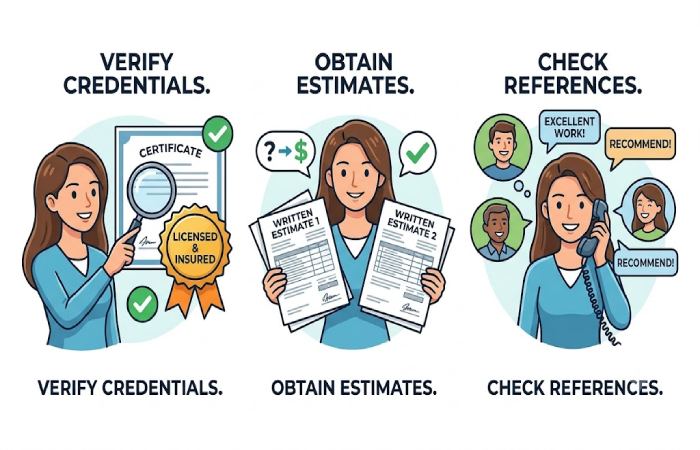
Customer comments will only get you so far. Before committing to a contractor, be sure that the contractor is appropriately licensed and insured, and has experience with jobs similar to the ones you need done.
You will want to acquire estimates in writing and ask for recent customer references. Carefully review warranty documentation and make sure that your choice is not based solely on “star ratings” available online but is based on sound criteria.
Questions to Ask Before Signing a Contract
| Question | Why Ask It? |
| Are you licensed and insured? | Confirms legal compliance |
| Can you provide recent references? | Verifies previous customer satisfaction |
| Do you provide written estimates? | Improves pricing transparency |
| What warranties do you offer? | Clarifies post-project support |
| Who will supervise the project? | Defines accountability |
| What is the expected timeline? | Sets realistic expectations |
| How are project changes handled? | Prevents billing misunderstandings |
| Will permits be arranged? | Clarifies responsibilities |
Where to Research an Electrical Contractor
Always get recommendations and reviews from a wide array of reliable sources. It is possible to see details about contractors through licensing authorities, as well as on business websites, through advice and support from friends, and via professional business organizations. Take into account feedback from more than one source when deciding on whether a specific contractor is qualified and has positive reviews.
There also is direct communication that should play a role. Talking to a contractor and reading his or her estimate and asking specifics can offer more insight than many online reviews will tell you.
Pros and Cons of Relying on Online Reviews
| Pros | Cons |
| Learn from previous customer experiences | Reviews may lack full context |
| Compare contractors more easily | Individual experiences vary |
| Identify recurring service patterns | Some reviews may be outdated |
| Evaluate communication quality | Ratings alone don’t show qualifications |
| Discover strengths and weaknesses | Reviews cannot replace credential verification |
Final Thoughts
Researching an electrical contractor should involve more than comparing review scores. Online feedback can provide useful insights, but it should be combined with objective factors such as licensing, insurance, experience, references, written contracts, and direct communication.
By using a reasonable approach and following up from several places, businesses and even households will discover the ability to hire better and with fewer of those awful experiences in a contract.